
 Read on Twitter
New paper in Criminology with @ChrisMelde @DrMeldrum and Donna Coffman
https://onlinelibrary.wiley.com/doi/full/10.1111/1745-9125.12268……
I know, I know, another test of self-control theory, now in it’s 4th(!) decade, but read this thread to learn about the "forgotten chapter"
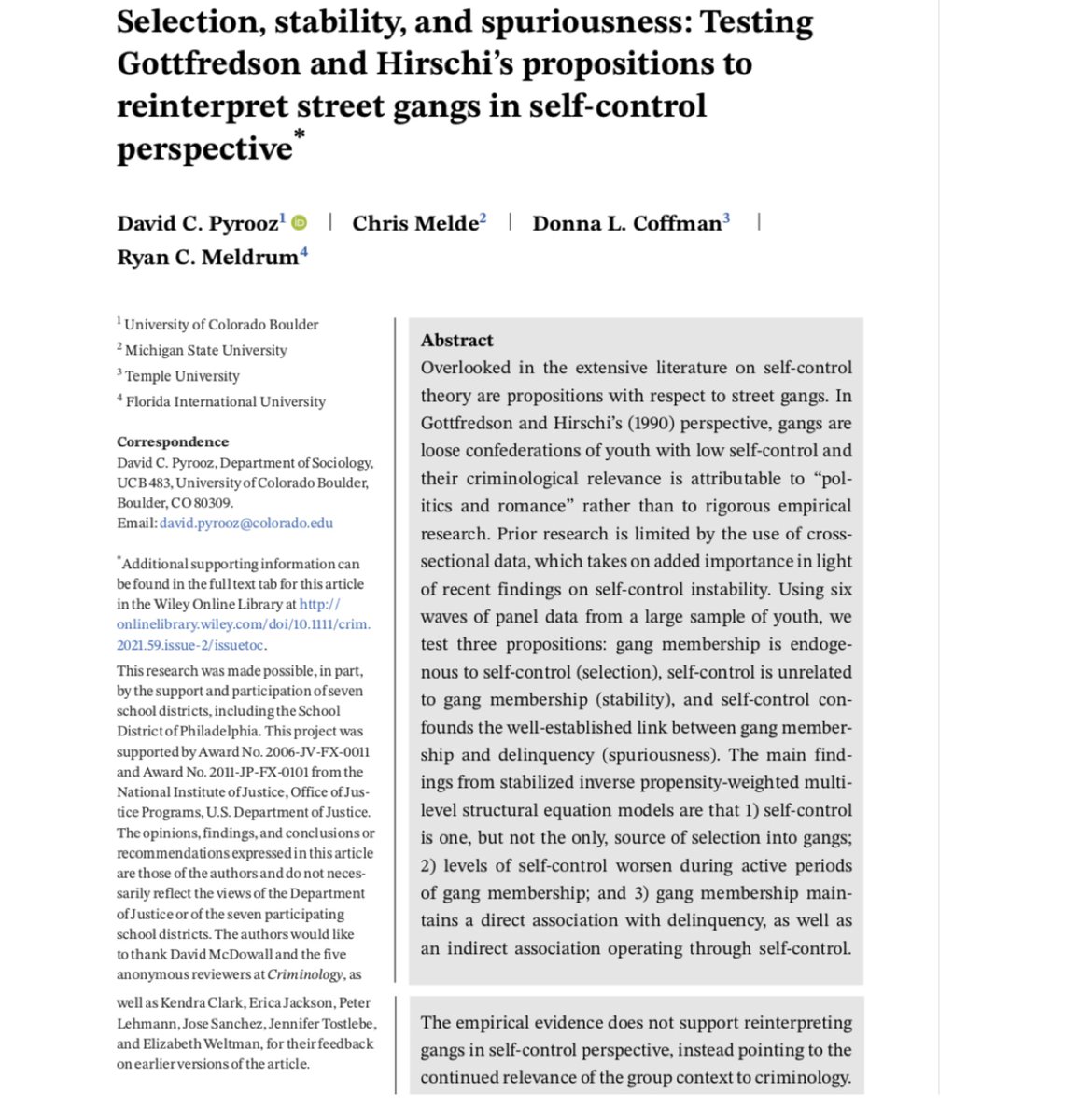
https://onlinelibrary.wiley.com/doi/full/10.1111/1745-9125.12268……
I know, I know, another test of self-control theory, now in it’s 4th(!) decade, but read this thread to learn about the "forgotten chapter"
The entire notion of “gangs” has long been contested. There are at least three variants of this.
First, some see gangs as more as social movements of resistance to hegemonic structural forces. Brotherton’s article is a good example of this: https://journals.sagepub.com/doi/abs/10.1177/1362480607085794
First, some see gangs as more as social movements of resistance to hegemonic structural forces. Brotherton’s article is a good example of this: https://journals.sagepub.com/doi/abs/10.1177/1362480607085794
Second, others take a different position, the “red herring” argument, contending that gangs are a distraction from the larger youth violence problem. Sullivan’s article is a good example of this: https://journals.sagepub.com/doi/abs/10.1177/1043986204272912… ( @Abt_Thomas and @DavidKennedyNYC
make similar arguments)
make similar arguments)
And, finally, there is Gottfredson and Hirschi. Their view (obviously) fits within the broader control perspective.
They don't deny that gangs exist, but in a classic quote, attribute the criminological relevance of gangs to “politics and romance.”
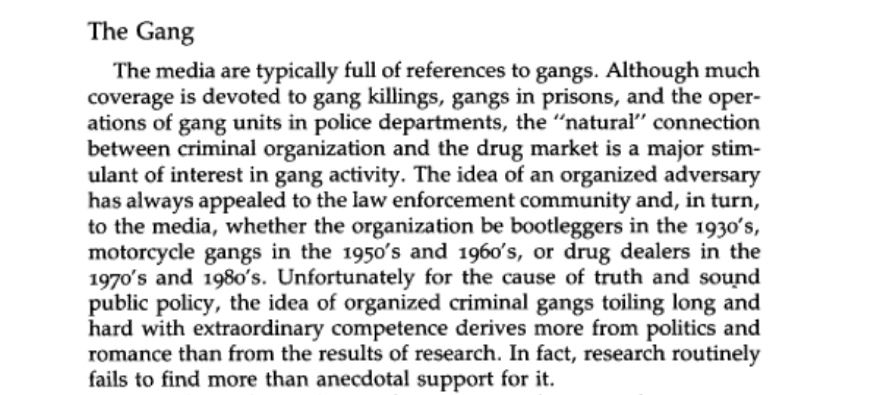
They don't deny that gangs exist, but in a classic quote, attribute the criminological relevance of gangs to “politics and romance.”
Similar to Kornhauser, who dubbed Thrasher a “pure control theorist” for his argument that gang-like groups emerge in communities with weak controls, G&H make an individual-level control argument:

If G&H are right, that changes everything. No more gang policing. No more gang research. No more special attention. Period.
It’s an abolition-like argument, not unlike Chapter 8 in
@alexvitale's book. Focus on improving self-control, and eliminate these “things” we call gangs.
It’s an abolition-like argument, not unlike Chapter 8 in
@alexvitale's book. Focus on improving self-control, and eliminate these “things” we call gangs.
For reasons that aren’t exactly clear to us, G&H’s propositions on gangs have been mostly ignored.
That's why we call Organization and Crime the “forgotten chapter” in their classic. The relevant research either focuses on peers or, if focused on gangs, is cross-sectional.
That's why we call Organization and Crime the “forgotten chapter” in their classic. The relevant research either focuses on peers or, if focused on gangs, is cross-sectional.
Is there evidence to reinterpret gangs in self-control perspective? Using data from GREAT2:
1. Does SC account for selection into gangs? (selection)
2. Is SC invariant to transitions into/out of gangs? (stability)
3. Is gang/crime link confounded by SC? (spuriousness)
1. Does SC account for selection into gangs? (selection)
2. Is SC invariant to transitions into/out of gangs? (stability)
3. Is gang/crime link confounded by SC? (spuriousness)
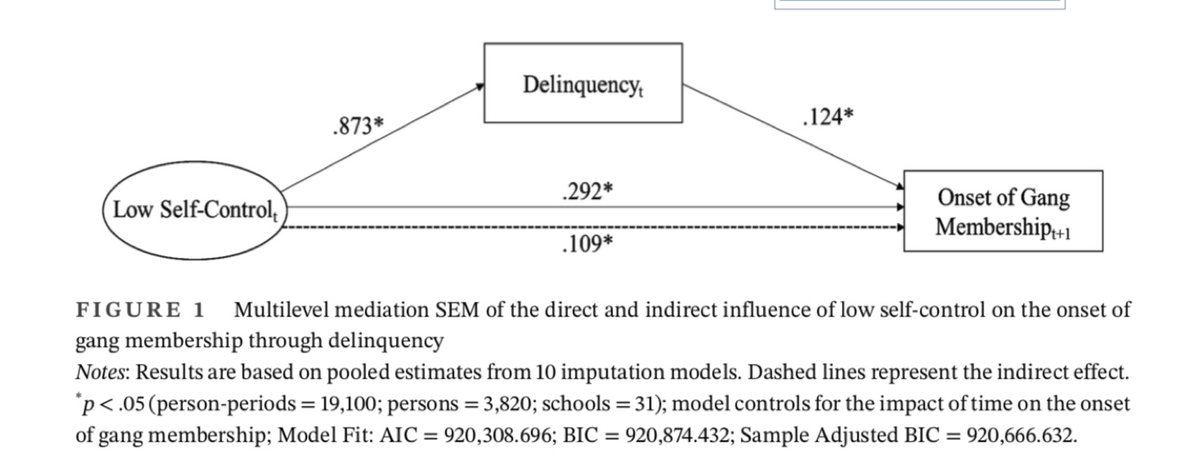
Here’s the answer to RQ1. We also found that cross-sectional data are problematic because they overstate the effect of SC on gang membership
Here’s the answer to RQ2. Na and Paternoster asked, in response to finding reductions in self-control, what are the social variable at work here? Our data suggest that gang membership is one of them.
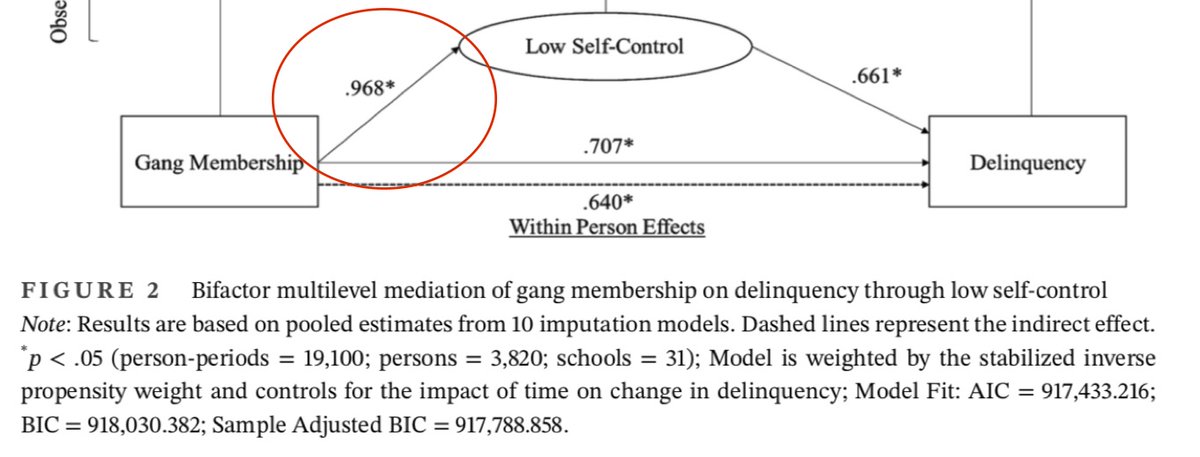
Here’s the answer to RQ3. This is perhaps the least surprising finding to people who have being paying attention the empirical literature (we @JTuranovic @DeckerCrime meta-analyzed 179 studies back in 2013)
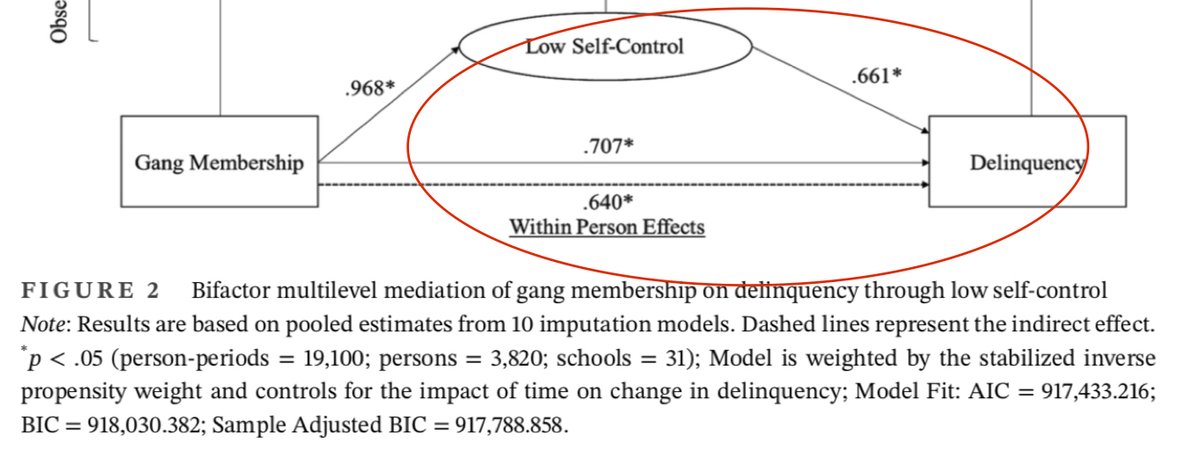
In the end, G&H on are board, but they miss the bullseye.
Group dynamics are important to understand, maintain criminological relevance, and are not simply about politics and romance. Gangs are not reducible to mere confederations of youth with poor self-control.
Group dynamics are important to understand, maintain criminological relevance, and are not simply about politics and romance. Gangs are not reducible to mere confederations of youth with poor self-control.
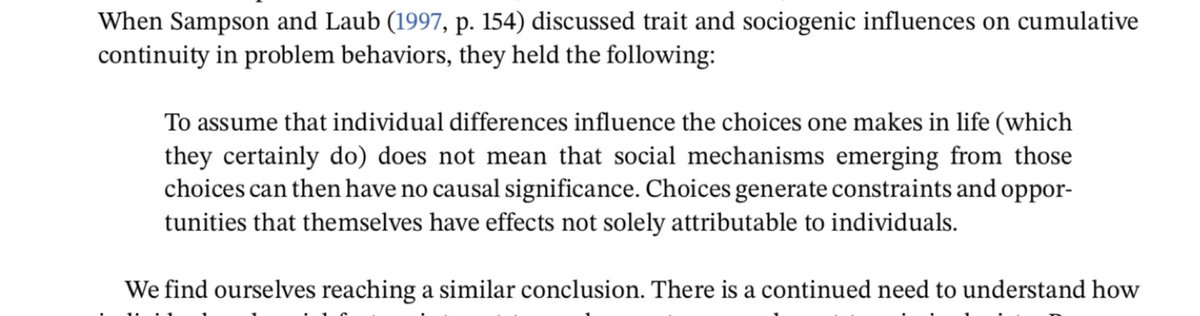
Here’s the quote we ended with, from Sampson and Laub in their piece on cumulative contintuity:
If you made it this far, and you don’t have access to CRIM/Wiley, here’s an unrated pre-print posted to ResearchGate: https://www.researchgate.net/publication/347512139_Selection_Stability_and_Spuriousness_Testing_Gottfredson_and_Hirschi's_Propositions_to_Reinterpret_Street_Gangs_in_Self-Control_Perspective


