
 Read on Twitter
 How to use Urine Electrolytes for assesment & diagnosis of Kidney Disorders?
A great article in @CJASN
 https://cjasn.asnjournals.org/content/14/2/306
 Summary of the article is in this
#MedEd
#FOAMed
#NephPearls
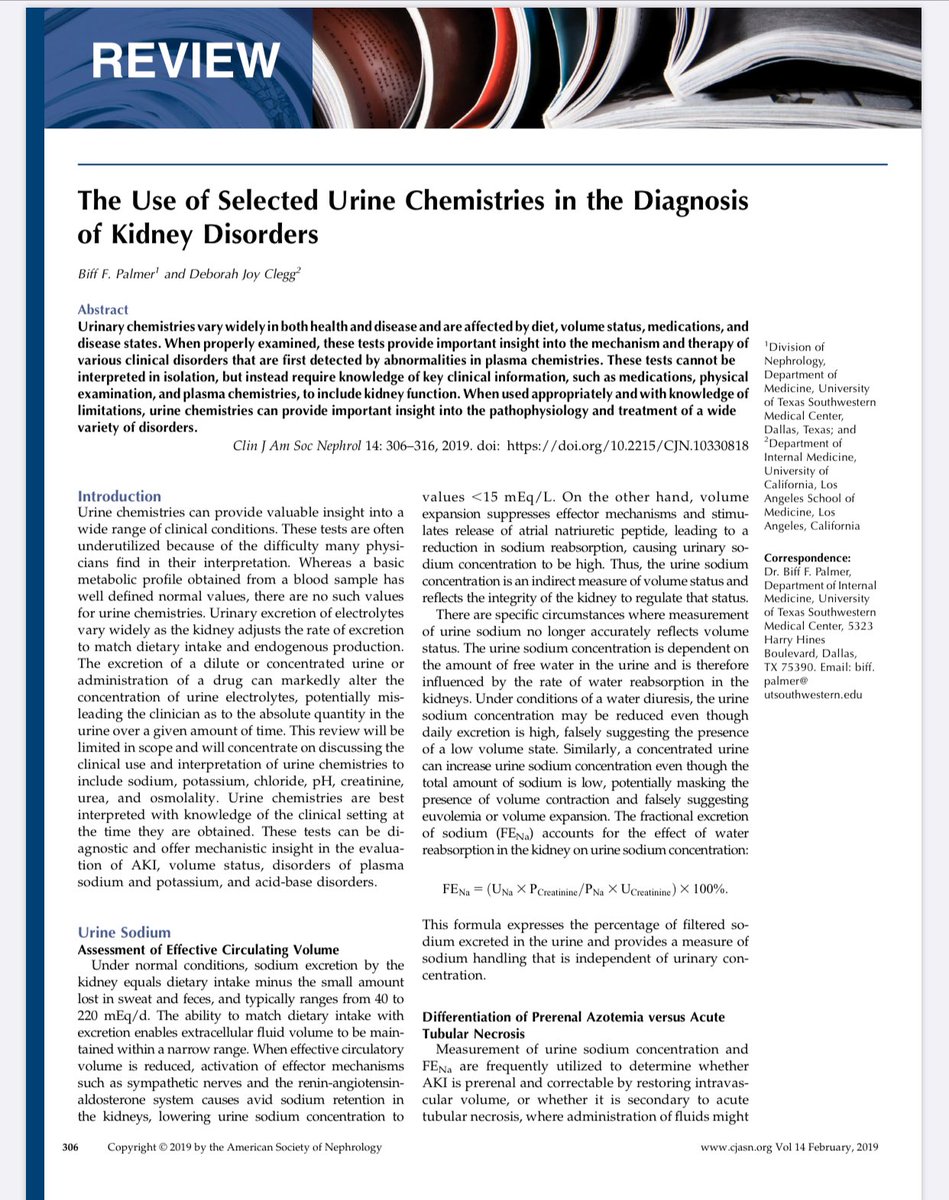 Urine Na is used for:Assessment of effective circulatory volume Differentiation of Pre-renal Azotemia vs. ATN
Spot Urine NaUrine Na < 15 mEq/L suggests
Urine Na is used for:Assessment of effective circulatory volume Differentiation of Pre-renal Azotemia vs. ATN
Spot Urine NaUrine Na < 15 mEq/L suggests  effective circulatory volume BUT the caveat is:
 Spot Urine Na is dependent on the amount of ‘water’ in the urineHence spot Urine Na can be in the setting of water diuresis &
  always mean volume
This is why we use Fractional Excretion of Sodium: FeNa
always mean volume
This is why we use Fractional Excretion of Sodium: FeNa FeNa = (UNa x PCr/ PNa x UCr) x 100
FeNa provides a measure of Urine Na handling independent of urine concentration (meaning independent of the ‘water’ in the urine)
FeNa is used to differentiate b/w Pre-Renal Azotemia & ATN FeNa < 1% suggests Pre-renal Azotemia & hence volume-responsive whereas a  FeNa suggests ATN and hence not volume-responsiveBut FeNa is NOT always reliable in making this distinction
Limitations of FeNa:There are conditions that cause ATN but also cause intense renal vasoconstriction resulting in filtered load of Na, resulting in FeNa despite presence of ATN
FeNa suggests ATN and hence not volume-responsiveBut FeNa is NOT always reliable in making this distinction
Limitations of FeNa:There are conditions that cause ATN but also cause intense renal vasoconstriction resulting in filtered load of Na, resulting in FeNa despite presence of ATN SepsisIV contrast NSAIDsRhandomyolysis
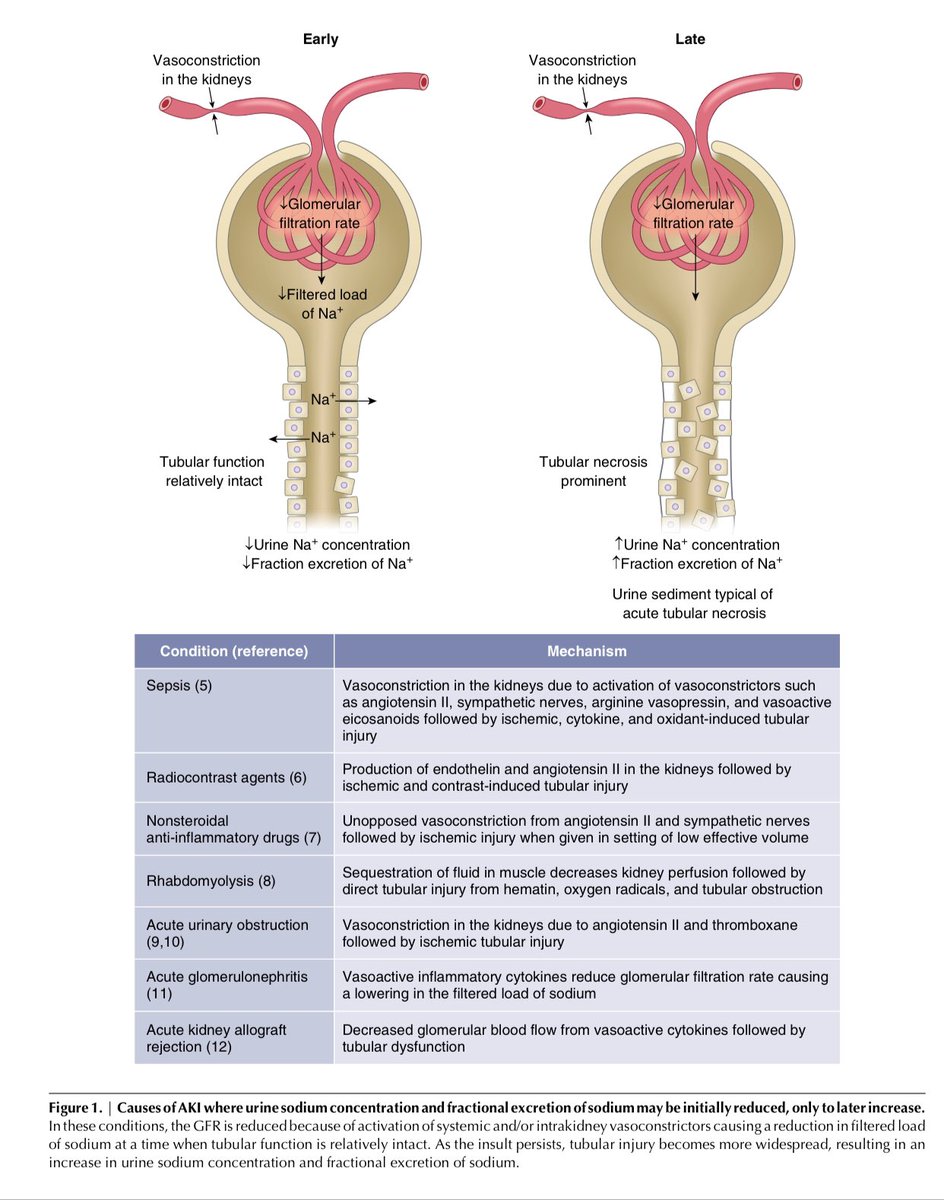 FeNa can also be misleadingly in the following conditions despite presence of ATN:CHFCirrhosis Extensive burns Intense neurohumoral activation =
 Low FeNa
FeNa can be misleadingly despite effective circulatory volume in the setting of diuretic use (due to natriureis): In this situation, Fractional Excretion of Urea (FeUrea) can be used
FeUrea = (Ur Urea x Pcr/ P Urea x Ucr)x 100
= < 35% suggests
volume volume -> prox. tubular water & urea reabsorption FeUreaSo w/ distal diuretic use, loop or thiazides, but NOT w/ proximal diuretic use, FeUrea can be of help
FeNa can be misleadingly despite volume when: volume is accompanied by in non-reabsorbable anions in urine, such as HCO3-, as HCO3- is excreted in urine paired w/ Na+Use Urine Cl and NOT FeNa to assess volume status in met. alkalosis
This is why in metabolic akalosis, Urine Cl is used as a marker to determine whether the metabolic alkalosis would be responsive to Cl-containing IVF or not: Urine Cl: responsive to IVF Urine Cl: not responsive to IVF
Urine Chloride (Cl) excretion mirrors Urine Na excretion & hence both move in the same direction in response to changes in the effective circulatory volume Except when volume changes are accompanied by Acid-Base disorders
If Urine Na to Urine Cl ratio is >1.6 in the setting of volume then:An accompanying anion is causing obligatory Na loss in the urine despite an appropriately Urine Cl in response to neurohumoral activation due to effective circulatory volume
If UNa to Ur. Cl ratio is >1.6 in the setting of circulatory volume then:Check Urine pH: this will help identify the Non-reabsorbable Anion causing the obligatory Na lossUr. pH 7-8 = BicarbonaturiaUr. pH < 6 = Ketoanions or Drugs

 If the Urine Na to Urine Cl ratio is
 < 0.7 in the setting of
effective circulatory volume then that suggests:An accompanying cation in the urine causing obligatory Cl lossEg. ammonium excretion in urine as it is excreted as ammonium chloride
Urine Cl is helpful in work-up of:Metabolic Alkalosis &Metabolic Acidosis
 Urine Potassium (K)In Hypokalemia,
 Step 1:
 determine if K loss is renal or extra-renalCheck Spot Urine K
< 5-15 mEq/L = extra-renal K loss
> 40 mEq/L = renal loss
But Spot Urine K can be misleading as it can vary w/ urine concentration
To overcome this limitation of Spot Urine K one can use the following:Urine K to Urine Creatine ratio Ratio of < 13 mEq/g OR
Ratio of < 2.5 mEq/mmol Both indicate extra-renal K loss
Once it is determined that hypokalemia is due to renal or extra-renal loss based on the: Urine K to Urine Cr ratio then the next steps are:
Step 2:
Check BP & assess effective circulatory volumeStep 3:
Plasma HCO3Step 4:
Urine Chloride
 Urine Anion Gap & Urine Osmolar Gap in Metabolic Acidosis In normal anion gap matabolic acidosis, determine if the source of the acidosis is renal or extra-renalCalculate Urine Anion Gap (UAG):
(Urine Na + Urine K) - Urine Cl
Positive UAG = source of met. acidosis is renal Negative UAG = source of met. acidosis is extra-renalWhy?Because
urine ammonium excretion by the kidney in the setting of metabolic acidosis means that the kidney is NOT getting rid of the acid
Why is Urine Anion Gap positive in the setting of urine ammonium excretion?Because ammonium is excreted as ammonium chloride, now recall the UAG equation:
(Urine Na + Urine K) - Urine Cl
So
ammonium excretion in urine = Urine Cl = Positive UAG
Urine Anion Gap can also be misleading - Why?Recall that in the UAG equation we are only accounting for Urine Na, K & Cl So presence of ANY unmeasured ions (besides Na, K, Cl) can be misleading: KetoacidsNa HippurateD-lactate
When UAG is not reliable to assess urine ammonium excretion then use: Ur. Osmolal Gap
Ur. Osm. Gap >100 mOsm/kg=
ammonium excretion= Met. acidosis cause is extra-renalLimitations: Ur. Osm. Gap can be
due to non-ammonium solutes (mannitol, alcohols)
 Thisis a review of how to use the following urine chemistries to assess & diagnose kidney disorders Urine SodiumFractional excretion of NaFractional excretion of UreaUrine ChlorideUrine PotassiumUrine Anion GapUrine Osmolar Gap
End/


