
 Read on Twitter
1/ Every once in a while clouds pay us an unwelcome visit at Paranal. This can ruin our observations, but on the other hand we can enjoy amazing Moon halos like this one I saw in November. Do you want to learn how these haloes form? Thread!

2/ These haloes are created by hexagonal ice crystals in the atmosphere. Incident light rays are refracted twice as they go through two faces of the crystals at 60º with each other. The beam then emerges at a certain deviation angle relative to the incident beam.

3/ The red curve shows the deviation angle for any incident angle. There’s a minimum deviation angle at 22º: beams can’t be refracted at smaller angles. This minimum angle is also the most probable one: if you shoot beams at random angles, they’ll most likely come out at 22º.
4/ When light from the Sun / Moon go through a myriad of small ice crystals, most beams emerge at 22º, and you’ll thus see a bright ring of this size. The inside of the halo is dark because beams can’t be refracted at less than 22º.
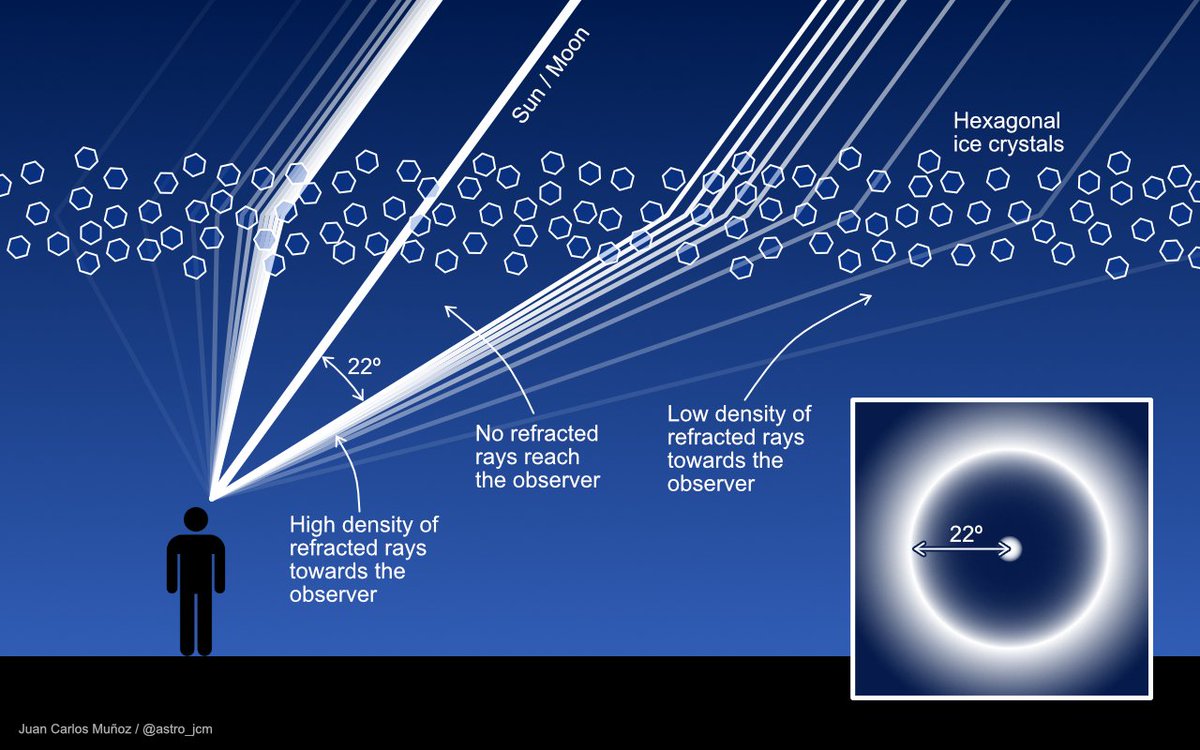
5/ To be clear: crystals inside and outside the halo also refract light rays at 22º. You just don’t see them because they don’t travel in your direction. But they’ll reach someone else! Two observers side by side will see two different haloes.
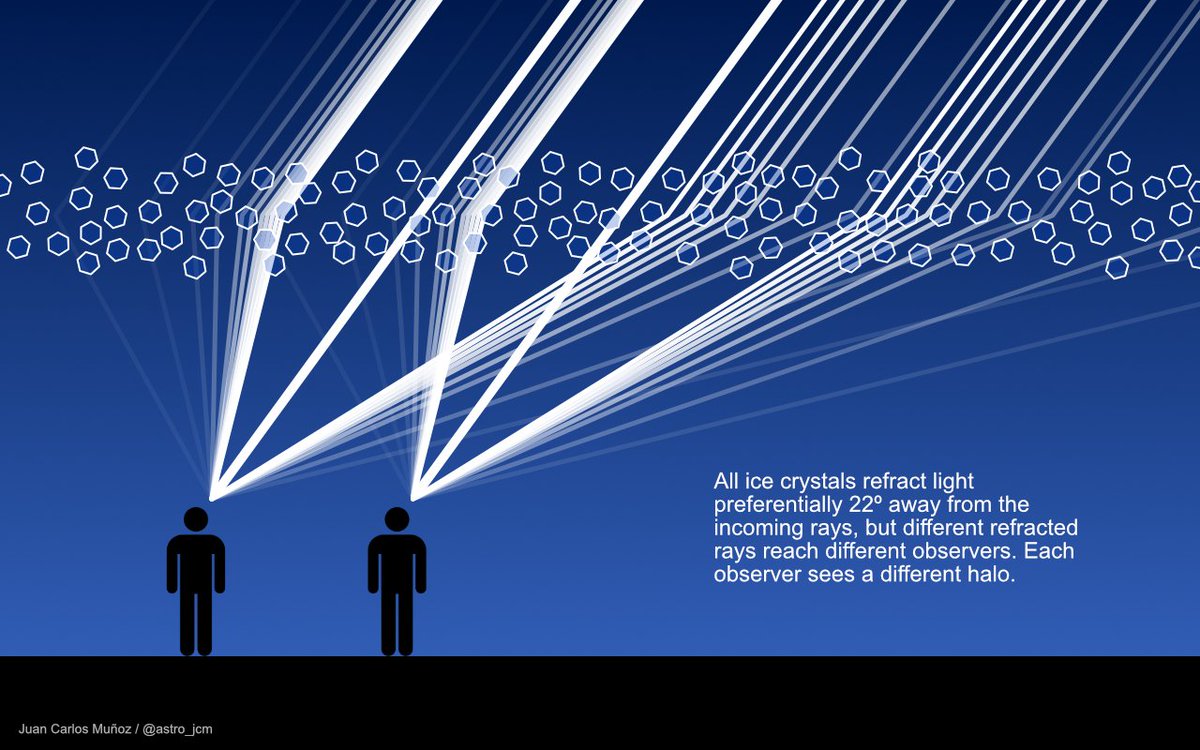
6/ Same thing with rainbows: when you see one, you’re the only person in the world seeing that particular rainbow! Haloes and rainbows aren’t real images but virtual ones: they aren’t located at any specific distance. There’s not a pot of gold at the end of the rainbow, sorry!
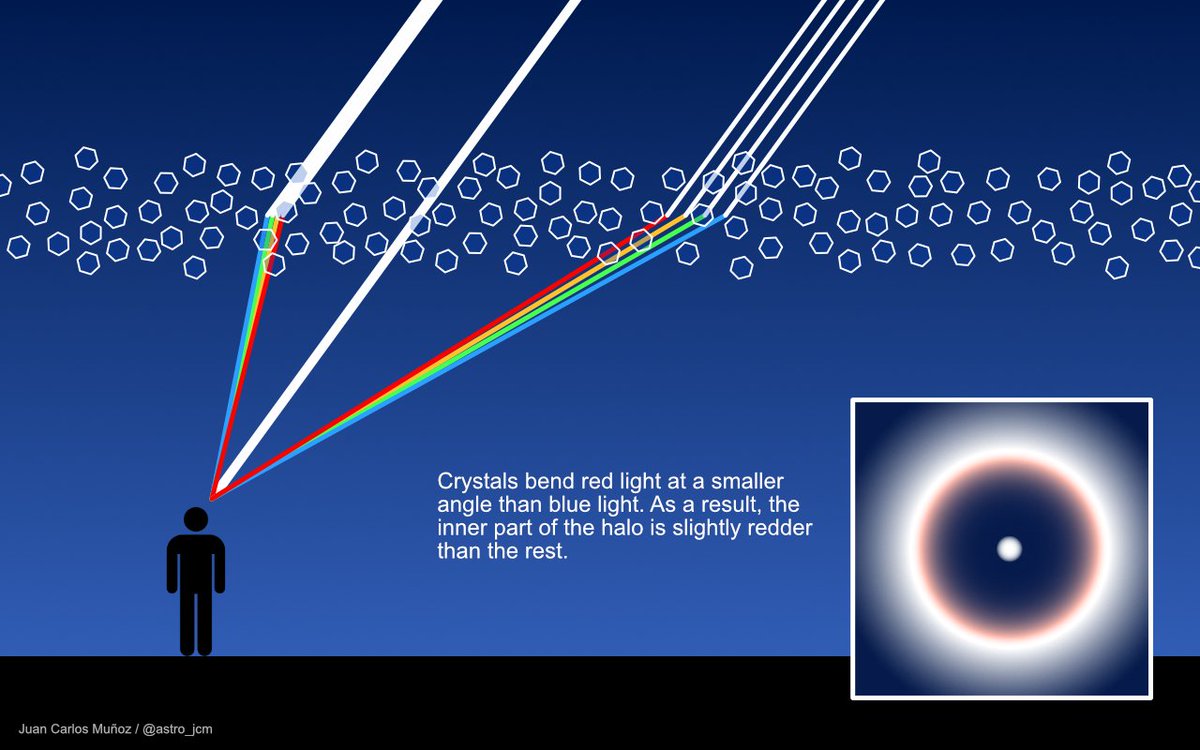
7/ Speaking of rainbows: did you notice that the inner part of the halo in my original image is somewhat red? That’s because ice crystals don’t bend red light as much as blue light, so the red halo is slightly smaller than at other colors.
8/ This isn’t the only halo created by hexagonal ice crystals. The facets that are perpendicular to each other create a 46º halo, twice as large as the 22º one. But since light is more spread out, this halo is much harder to see; it’s fainter and has softer edges.
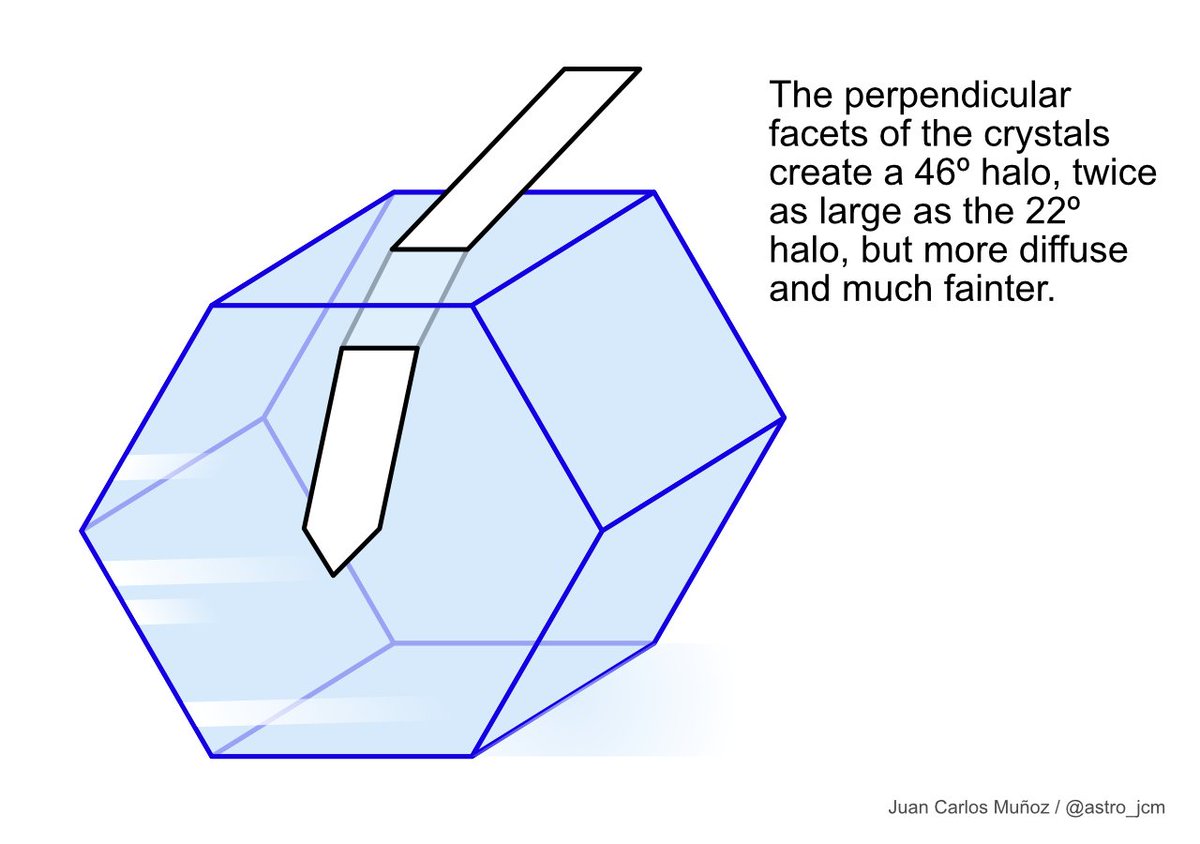
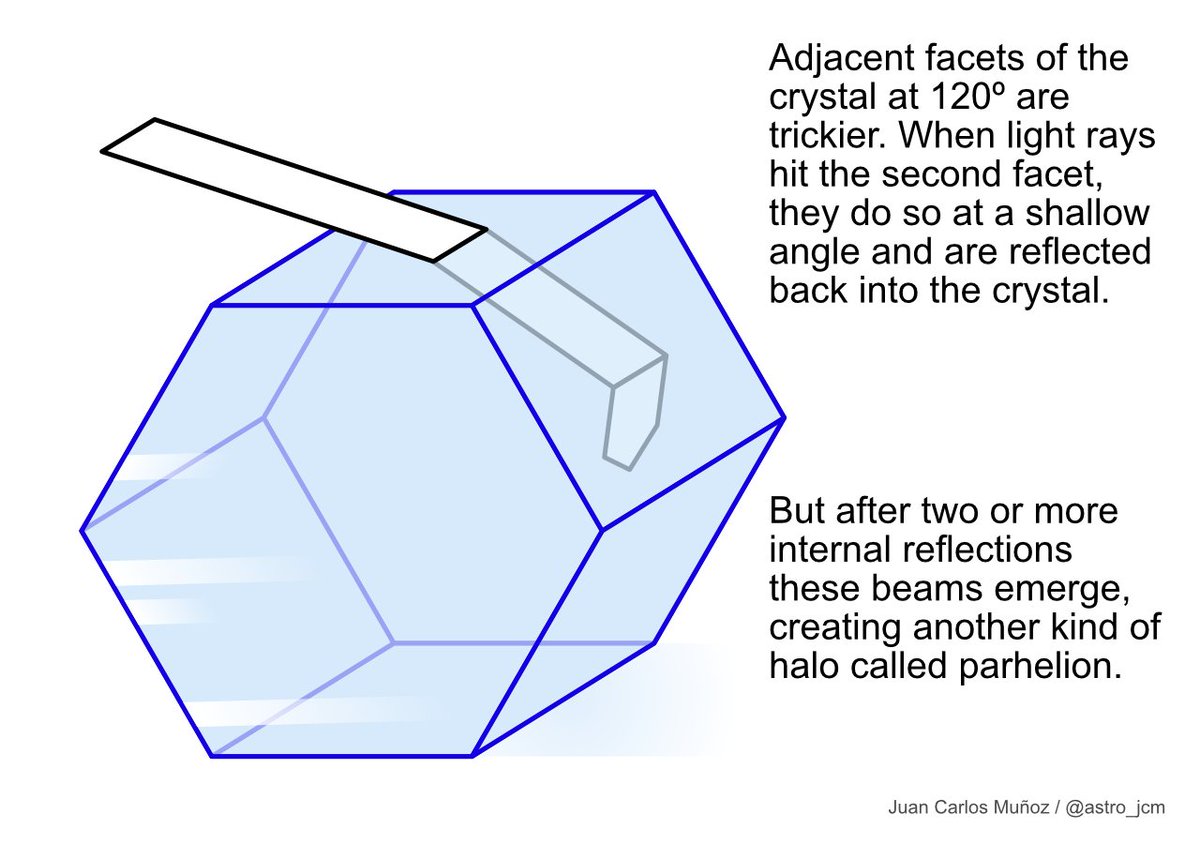
9/ Facets at 120º are special, because when the light beam hits the second facet it bounces back into the crystal. It’s like when you’re underwater in a swimming pool very close to the surface: you can’t see the outside, just reflections of what's under the water.
10/10 If you want to learn more, check out the webpage below. It contains lots of examples of atmospheric optical phenomena. My favourite part is how haloes would look like in other planets due to ice crystals of different shapes and compositions. https://www.atoptics.co.uk/


